
















 English (US)
Retail store compliance is one of the most expensive problems that most chains are not consistently measuring. Visual merchandising standards, planogram requirements, promotional display specifications, health and safety protocols: these govern how every location should operate. But in chains with dozens or hundreds of stores, the most common measure of compliance is the scheduled audit. And an audit only tells you what things looked like on the day someone visited.
The problem with scheduled compliance audits is that they measure a moment, not a pattern. A store manager who knows the district visit is on Tuesday makes sure Tuesday looks right. What happens Wednesday through Monday, across 200 locations, is largely unknown. Between visits, compliance is assumed.
This is not a management failure. It is a structural one. At scale, manual compliance is a sampling problem. A team of compliance officers can visit each location once or twice a year, maybe once a month in well-resourced chains. The rest of the time, the store runs on the expectation that it is meeting standards, not the verification of it.
The business case for closing this gap is cleaner than most retailers expect. Research consistently shows a 10 to 30 percent lift in sales for properly executed promotional displays versus non-compliant ones. A feature display set up wrong, placed in the wrong zone, or populated with the wrong product does not just miss the lift. It actively underperforms the baseline. Multiplied across hundreds of locations running dozens of campaigns simultaneously, revenue leakage from non-compliant execution is a significant and largely invisible drag on promotional ROI.
The compliance picture becomes more complex when regulatory dimensions enter. OSHA citations for serious violations in retail environments start at $15,625 per citation. Willful or repeated violations reach $156,259. State and local layers add food handling requirements, accessibility standards, occupancy limits, and fire code compliance that vary by jurisdiction. A chain operating across multiple states is managing a compliance surface that quarterly field visits were never designed to cover adequately.
What continuous monitoring changes
The shift AI enables here is not faster compliance checks. It is the change from sampling to continuous coverage.
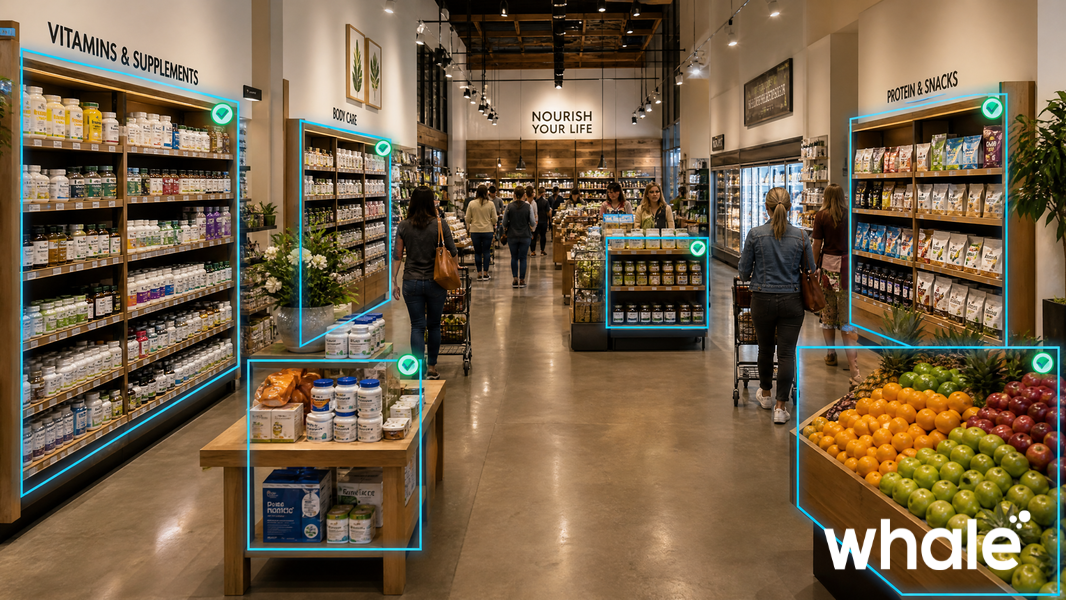
A camera network already running in your locations can verify, in real time, that the promotional display in zone three matches the planogram from corporate, that the required safety signage is in place, that the closing checklist was followed last night, and that staff-to-floor ratios in high-traffic zones meet the operating standard. Not on audit day. Every day.
Compliance exceptions surface immediately, route to the right person, and close with documented resolution. The store manager does not wait three weeks to learn that the endcap placement is wrong. The compliance team does not discover a planogram deviation after the campaign has already ended.
For multi-location retailers, this changes the math on promotional ROI meaningfully. When execution compliance rates move from 70 to 90 percent, the lift that corporate planned for in a campaign actually materializes at scale, not just in the flagship locations that tend to get more attention, but across the network.
At the regulatory level, continuous monitoring creates an audit trail that scheduled inspections never could. When a violation is alleged, there is a documented record of what was happening in that location continuously, not just on the last scheduled visit.
The compliance gap in retail is not a new problem. The ability to address it without adding field teams is newer than most operators have had time to absorb.
How Whale approaches this
Whale's SpaceSight is built for exactly this problem. Using existing in-store camera infrastructure, SpaceSight continuously monitors compliance across every location in real time, from planogram adherence and display execution to safety signage and operational checklists. Exceptions surface immediately and route to the right person, without adding headcount or scheduling another field visit.
For retail operators managing compliance across dozens or hundreds of locations, the shift from periodic auditing to continuous monitoring is where the gap between planned performance and actual performance starts to close. Learn more at meetwhale.ai.
Used in this article:
OSHA — Retail Industry: osha.gov/retail
Wiser Solutions — Retail Execution & Compliance Research 2025: wisersolutions.com/resources
NRF — 2025 Retail Operations Report: nrf.com/research
Axonify — Retail Compliance: A Complete Guide 2026: axonify.com/blog/retail-compliance
McKinsey — The State of Fashion 2025: mckinsey.com/industries/retail/our-insights
- In-Store Retail Media Measurement: Why 84% of Sales Happen Where 1% of Ad Spend Goes
- Retail Workplace Violence Prevention: What AI Catches Before Panic Buttons Help
- AI Retail Loss Prevention: Why $90 Billion in Annual Shrink Demands a New Approach
- The $9 Billion OOH Attribution Gap: Why Physical Ad Spend Still Runs on Faith
- Retail Store Compliance Monitoring: Why Audit Day Tells You Almost Nothing
- Energy, Passion, and the Future of AI
- Introducing Echo
- Whale Raises $40M Series C3 Extension, Bringing Total Series C to $100M, to Scale Global Enterprise AI Operations
- Check Out Whale's Open Space, Where AI Meets the "Lead to Win" Spirit
- Whale Secures $60 Million to Expand its Enterprise AI Suite Globally
- How SpaceSight Works in Standardizing and Improving Operational Efficiency for Car Workshop
- 3 Ways to Improve Conversion Rate for the Automotive Industry
- How GIORGIO ARMANI Redesigned Success Metrics Across Multiple Stores
- How GXG Leveraged Footfall Analytics for Smarter Employee Management
- From Browsing to Buying: Use SpaceSight to Optimize Sales Through Product Placement
- How Supermarket Chains Improve Inspection Efficiency with Smart Technology
- How SpaceSight Improved Inspection Efficiency for Chain Restaurants
- Four Management Practices to Ensure Food Safety in Your Kitchen
- Build Consistent Customer Dining Experience with SpaceSight Onsite Inspection
- Why Retail Managers Need Inspection Software for Store Management
- How to Use Footfall Analytics to Improve Customer Service
- Navigating the Future of Retail with AI with OPPO Indonesia







-
 Capability Maturity Model Integration Certification
 -
 Information Security Management System Certification
 -
 Quality Management System Certification
 -
 Accreditation@SGD Certificate from the Singapore Infocomm Media Development Authority
 -
 SOC 2, System and Organization Controls 2
 -
 HIPAA Compliant
 -
 General Data Protection Regulation (GDPR)
-
 Schedule a demoProfessional consultants will provide a brief explanation lasting at least 20 minutes to help you evaluate and use Weve products more efficiently. Please leave your contact information, and we will contact you as soon as possible to schedule a demonstration time.
 -
 Scan to followStay updated with the latest news anytime, anywhere
 Whale Instagram Page
 Whale Linkedin Page
 -
 Customer Service CenterProvide one-on-one consultation and technical support for products and solutions
-
 Back to top